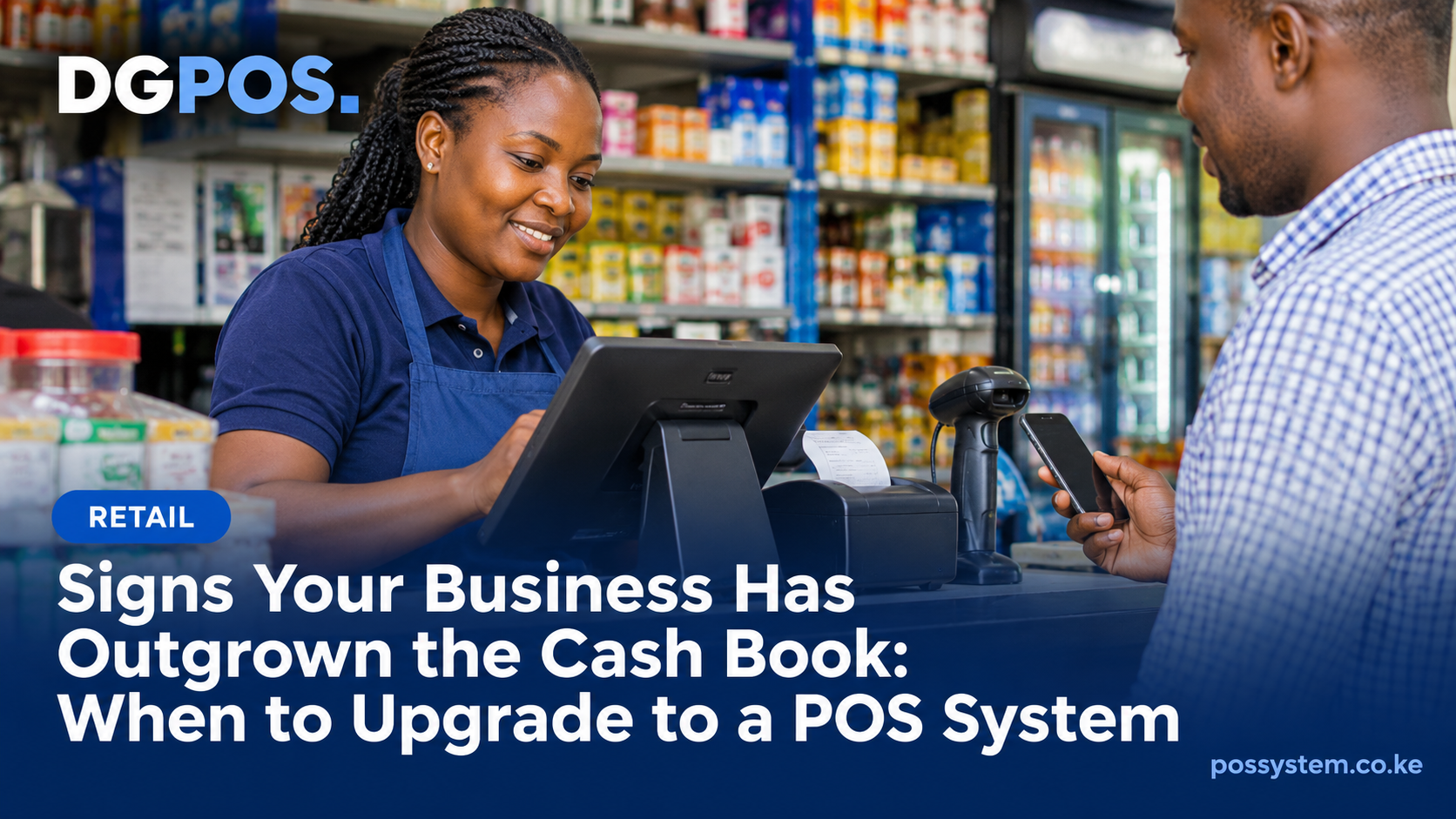
When starting a small business, a cash book is often one of the simplest ways to record daily financial transactions. It helps business owners track money received, expenses paid and the remaining cash balance. For a small shop with a few customers and limited products, this method may be sufficient.
However, as a business grows, daily operations become more complicated. More customers visit the shop, product varieties increase, employees handle transactions and stock movements become harder to monitor. What once seemed like a simple recordkeeping method can gradually become a source of delays, errors and missing information.
Many Kenyan businesses continue using manual cash books even after their operations have expanded. They may record sales in notebooks, calculate daily totals using calculators and update stock information separately. Although these methods can work initially, they may struggle to support a business handling many transactions every day.
Recognising when your business has outgrown the cash book is important. It helps you identify when better tools are needed to manage sales, inventory and financial information.
A reliable POS solution can help businesses move beyond manual transaction recording. A suitable Point Of Sale system can organise sales information, connect transactions with product records and provide useful business reports. With modern pos software, retailers can improve accuracy, monitor product movement and make more informed decisions.
In this guide, Digee Technologies Limited Company explores the signs that your business has outgrown the cash book and explains how upgrading to a suitable POS SYSTEM can support business growth.
1. What Is a Cash Book?
A cash book is a financial record used to document money received and money paid out by a business. It helps business owners monitor cash transactions and understand how money moves through their operations.
A typical cash book records:
- Date of each transaction.
- Description of the transaction.
- Money received.
- Money paid out.
- Payment method.
- Daily or running balance.
For example, a small retail shop may record the following transactions:
| Description | Money Received | Money Paid |
|---|---|---|
| Morning sales | KSh 5,000 | – |
| Supplier payment | – | KSh 2,000 |
| Afternoon sales | KSh 3,500 | – |
| Transport expense | – | KSh 500 |
| Total | KSh 8,500 | KSh 2,500 |
This information helps the owner understand the cash transactions recorded during the day.
However, a cash book is not a complete business management system. It does not automatically provide detailed product sales analysis, stock tracking, customer purchase histories or other operational reports.
As the business expands, a dedicated Point Of Sale solution may become more practical.
2. Your Business Handles More Transactions Than Before
Carrefour Kenya’s revenue grows by Sh5bn amid expansion – Business Daily
One of the first signs that your business has outgrown the cash book is an increase in daily transactions.
When a shop serves only a few customers, recording each sale manually may be manageable. However, as customer numbers increase, employees may struggle to write down every transaction accurately.
Imagine a minimart that initially serves 20 customers daily. The owner can easily record sales in a notebook. A few months later, the business begins serving 100 or more customers every day.
Recording each transaction manually now requires more time and attention.
Common challenges include:
- Long checkout queues.
- Delays when calculating totals.
- Forgotten transactions.
- Incorrect calculations.
- Difficulty reviewing individual sales.
- Incomplete daily records.
A reliable POS solution helps businesses record transactions in an organised way. Cashiers can select or scan products, process payments and save sales information through the system.
A suitable POS SYSTEM can make checkout operations more efficient, especially when transaction volumes increase.
3. You Spend Too Much Time Calculating Daily Sales
Manually calculating daily sales can become exhausting when a business handles many transactions.
At the end of every working day, employees may need to add figures from several pages, subtract expenses and compare the totals with the available cash.
This process can take considerable time, especially when multiple employees record transactions in different notebooks.
Manual calculations can also introduce errors. A small addition mistake may affect the final sales figure and make it difficult to understand the business’s actual performance.
With suitable pos software, completed transactions can be recorded and organised automatically. Depending on the system’s features, business owners can access daily sales summaries without manually adding every transaction.
A reliable Point Of Sale system can help you:
- Review daily sales totals.
- Compare sales across different periods.
- Monitor recorded transactions.
- Identify unusual sales activity.
- Reduce repeated manual calculations.
If you regularly spend hours calculating sales instead of managing your business, it may be time to consider a more efficient POS solution.
4. You Frequently Discover Missing or Incorrect Records
4 Kesalahan Fatal UMKM yang Sering Diabaikan, Nomor 1 Bikin Bisnis Diam-Diam Rugi!
Another warning sign is frequently discovering missing entries, incorrect figures or incomplete transaction records.
Manual recordkeeping depends heavily on employees remembering to document every transaction. During busy periods, a cashier may forget to record a sale, enter the wrong amount or write an unclear description.
These mistakes can make it difficult to reconcile business records.
Common examples include:
- Sales recorded under the wrong date.
- Transactions entered twice.
- Missing expense records.
- Incorrect product descriptions.
- Unexplained differences between recorded and actual cash.
- Pages containing incomplete information.
A properly configured POS SYSTEM can help reduce some of these challenges by recording transaction details electronically.
A Point Of Sale solution also makes it easier to review individual transactions, depending on available reporting and user-access features.
However, digital systems still require proper setup, employee training and regular checks. Incorrect product information or unauthorised changes can also affect electronic records.
5. You Cannot Easily Identify Your Best-Selling Products
A cash book usually records money received rather than providing detailed information about every product sold.
For example, a minimart may record KSh 15,000 in daily sales without clearly showing how much revenue came from bread, milk, cooking oil, sugar or detergents.
This makes it difficult to understand customer purchasing behaviour.
Without detailed product records, you may struggle to answer questions such as:
- Which products sell fastest?
- Which products generate the highest revenue?
- Which items contribute the most gross profit?
- Which products are becoming less popular?
- Which products need frequent replenishment?
A suitable POS system can connect individual sales transactions with product records.
With reliable pos software, business owners can review product sales reports and identify items that perform well.
This information can help you make better purchasing decisions, improve product displays and reduce unnecessary stock.
For businesses that want to understand customer demand, a POS SYSTEM offers more detailed sales information than a basic cash book.
6. Your Stock Records Are Frequently Inaccurate
POS System in Kenya for Mini Marts, Retail Shops and Supermarkets
geopos.geomodelconsultant.co.ke
Inventory management becomes more challenging as a business adds more products.
When you rely on manual stock records, employees may need to update inventory books whenever products are purchased, sold, returned or damaged.
If these records are not updated consistently, the quantities written in the stock book may differ from the actual quantities available.
For example, a shop’s notebook may indicate that 30 bottles of cooking oil remain in stock, while a physical count reveals only 18.
Such differences can affect purchasing decisions and create opportunities for stock losses.
A Point Of Sale system with inventory management features can connect recorded sales with stock quantities.
This may help businesses:
- Monitor product quantities.
- Review stock movement.
- Identify low-stock products.
- Record purchases and stock adjustments.
- Compare recorded stock with physical counts.
- Plan replenishment.
With suitable pos software, retailers can maintain more organised inventory information and improve visibility over their products.
7. You Keep Running Out of Popular Products
Running out of popular products is another indication that your existing recordkeeping process may no longer be sufficient.
Imagine operating a minimart where milk, bread, bottled water and cooking oil sell quickly. If you do not know how fast these products move, you may only discover that stock is low when customers start asking for unavailable items.
This can result in lost sales and disappointed customers.
A manual cash book may show how much money your business received, but it does not necessarily provide the stock movement information required for effective replenishment.
A suitable POS SYSTEM with inventory tracking can help you monitor fast-moving products and identify items approaching their reorder levels.
For example, if your business sells approximately 15 bottles of cooking oil daily, you can use sales history to estimate future stock requirements.
A reliable POS solution makes it easier to connect sales activity with stock planning, helping your business reduce unnecessary stockouts.
8. You Have Difficulty Tracking M-Pesa, Cash and Card Payments
EnventoryPro — Real-time Inventory Control (No Spreadsheets)
Many Kenyan businesses receive payments through several channels, including cash, M-Pesa and card payments.
Managing these payment methods manually can become complicated as transactions increase.
For example, a cashier may receive:
- KSh 5,000 in cash.
- KSh 8,000 through M-Pesa.
- KSh 3,000 through card payments.
If the records are not properly organised, it may become difficult to reconcile the total sales with the money received through each payment channel.
Common challenges include:
- Recording payments under the wrong method.
- Missing payment references.
- Difficulty comparing sales with settlement records.
- Confusion during cashier handovers.
- Delays when preparing daily summaries.
A suitable Point Of Sale system can help categorise transactions by payment method when these features are supported.
Some systems may also support payment integrations, depending on the provider and configuration.
With appropriate pos software, business owners can review recorded payment information and make reconciliation easier.
It is important to remember that recording an M-Pesa payment in a sales system is not the same as automatically confirming the payment with Safaricom. Any payment integration should be properly configured and tested.
9. Your Employees Struggle to Record Transactions Consistently
As your business grows, you may employ more cashiers, salespeople and supervisors.
Different employees may develop different ways of recording sales. One cashier may use abbreviations, another may write full product descriptions, while someone else may forget to include payment details.
This creates inconsistent records that are difficult to compare.
For example, the same product might appear under different names in your cash book:
- Cooking Oil 1L.
- Oil One Litre.
- 1L Cooking.
- Cooking Oil.
Although these descriptions may refer to the same product, analysing the records becomes more difficult.
A properly configured POS SYSTEM provides a consistent process for recording transactions.
Employees select products from an organised product list or scan compatible barcodes rather than repeatedly writing descriptions.
A suitable Point Of Sale system can also support individual user accounts and access permissions where available.
This helps business owners establish more consistent procedures across their teams.
10. You Cannot Easily Monitor Employee Sales
When a business has several employees handling transactions, it becomes important to understand who is processing sales and when transactions are being completed.
A traditional cash book may record the final daily totals without clearly identifying which employee handled individual transactions.
This can create challenges when investigating:
- Incorrect transactions.
- Unusual discounts.
- Refunds and returns.
- Cash differences.
- Missing records.
- Customer complaints.
A POS solution with user accounts and transaction history can help business owners review employee activity, depending on the system’s configuration.
A reliable POS SYSTEM may provide access controls that allow managers to assign different responsibilities to cashiers and supervisors.
This improves accountability and makes it easier to review business operations.
However, technology should support proper management practices rather than replace supervision, employee training and internal controls.
11. Preparing Business Reports Takes Too Much Time
Reporting automatisé : exploiter les données de son logiciel de caisse | JDC SA
Business reports help owners understand whether operations are improving or declining.
However, when all information is recorded manually, preparing reports may require reviewing several notebooks, receipts and spreadsheets.
You may spend hours trying to calculate:
- Total sales for the month.
- Daily revenue.
- Expenses.
- Product sales quantities.
- Payment method totals.
- Stock movement.
- Employee sales performance.
This makes it difficult to access useful information when making important business decisions.
A suitable Point Of Sale system can generate organised reports from recorded transactions, depending on available features.
With reliable pos software, business owners can review sales summaries and product performance more efficiently.
Instead of spending most of your time preparing reports manually, you can focus more attention on customers, employees and business growth.
12. Your Business Has Expanded to Multiple Branches
Managing one shop using a cash book may be possible, but operating several branches introduces additional challenges.
Each location may have separate employees, sales records, stock quantities and daily expenses.
If every branch uses a different notebook or spreadsheet, the owner may struggle to compare performance across locations.
For example, a retailer operating branches in Nakuru and Nairobi may need to understand:
- Which branch generates more revenue?
- Which location sells particular products faster?
- Where is inventory running low?
- Which products perform differently between branches?
- How much stock should be transferred between locations?
A suitable multi-branch POS SYSTEM can help centralise business information where supported.
A connected Point Of Sale solution may allow authorised managers to review branch sales, product movement and other operational information.
Before choosing a system, confirm whether it supports multiple locations, centralised product management and the reporting features your business requires.
13. You Find It Difficult to Separate Business Money from Personal Money
Many small business owners initially use the same cash for business purchases and personal expenses.
This can make it difficult to understand how much money the business is actually generating.
For example, a shop owner may withdraw money for personal use without recording the transaction separately. At the end of the month, the cash book may show unexplained differences.
Although a cash book can record withdrawals, expenses and other movements, the information must be entered correctly and consistently.
A more organised financial process should distinguish between:
- Customer sales.
- Business operating expenses.
- Supplier payments.
- Owner withdrawals.
- Business deposits.
- Other cash movements.
A POS solution can provide organised sales records, but it should not be confused with a complete accounting system.
Some pos software solutions support expense tracking or accounting integrations, while others focus mainly on sales and inventory.
Choose a system that matches your business needs and maintain proper financial records alongside it.
14. You Are Struggling to Track Customer Credit Sales
Some Kenyan businesses allow trusted customers to purchase products and pay later.
This is common in certain retail environments, hardware shops, wholesalers and businesses serving regular customers.
When credit sales are recorded manually, it can become difficult to track outstanding balances and payment histories.
Common problems include:
- Forgotten credit transactions.
- Incorrect customer balances.
- Missing payment records.
- Confusion about repayment dates.
- Disagreements over outstanding amounts.
A suitable POS SYSTEM with customer account and credit management features can help organise these transactions where supported.
A Point Of Sale solution may allow employees to associate transactions with customer records and review outstanding balances.
Before adopting a system, confirm that its credit management features match the way your business operates.
You should also establish clear credit limits, approval procedures and payment terms.
15. You Have No Reliable Way to Compare Business Performance Over Time
A cash book can provide historical transaction records, but analysing several months or years of information may take considerable effort.
As your business grows, you need to understand whether sales are increasing, declining or remaining stable.
For example, comparing monthly sales can help you identify:
- Seasonal sales patterns.
- Changes in customer demand.
- Products experiencing declining sales.
- Periods of increased revenue.
- The impact of promotional activities.
- Differences between weekdays and weekends.
A reliable POS system can make historical sales information easier to organise and review.
With suitable pos software, you can compare sales reports across different periods and use the information to guide business planning.
This helps you move from simply recording transactions to actively understanding business performance.
16. You Are Spending More Time on Paperwork Than Running Your Business
A business owner’s time is valuable. If you spend most of the day writing sales entries, calculating totals, checking stock books and searching for receipts, you may have limited time for activities that help the business grow.
These activities include:
- Serving customers.
- Negotiating with suppliers.
- Training employees.
- Improving product displays.
- Planning promotions.
- Expanding product selection.
- Developing new business opportunities.
Manual systems can create unnecessary administrative work as operations expand.
A suitable POS SYSTEM helps organise many routine sales activities in one place.
A reliable Point Of Sale solution can reduce repetitive data entry and make business information easier to access.
By adopting suitable pos software, you can spend less time searching through handwritten records and more time managing the business.
17. Cash Book vs POS System: What Is the Difference?
A cash book and a POS SYSTEM serve different purposes. A cash book is primarily used to record money received and paid out, while a Point Of Sale system can manage sales transactions and connect them with product and inventory information.
The following comparison highlights some important differences.
| Business Activity | Manual Cash Book | Suitable POS System |
|---|---|---|
| Recording sales | Manual entry | Electronic transaction recording |
| Calculating totals | Manual calculations | Automatic calculations |
| Product identification | Written descriptions | Product list or barcode scanning |
| Stock tracking | Separate manual records | Integrated inventory features where supported |
| Sales reports | Prepared manually | Generated reports where supported |
| Payment methods | Manually recorded | Payment categorisation where supported |
| Product performance | Difficult to analyse | Product sales reports where supported |
| Employee activity | Limited manual records | User and transaction records where supported |
| Multi-branch management | Requires separate records | Centralised management where supported |
| Transaction history | Handwritten entries | Searchable electronic records where supported |
The best choice depends on your business size, transaction volume and operational requirements.
A cash book may still be useful for recording certain financial movements, even after adopting a POS solution. Digital sales records and proper accounting records should work together rather than being treated as interchangeable.
18. When Is the Right Time to Upgrade to POS Software?
There is no single business size that determines when you should upgrade.
The right time depends on the problems you are experiencing and whether your existing recordkeeping process can support your operations.
You may need to consider upgrading when:
- Your business handles more transactions than you can comfortably record manually.
- Daily sales calculations frequently take too long.
- You regularly discover missing or incorrect records.
- You cannot easily identify your best-selling products.
- Stock quantities are difficult to monitor.
- You frequently run out of popular products.
- Multiple employees handle transactions.
- You accept several payment methods.
- You operate multiple business locations.
- Preparing sales reports has become difficult.
If several of these challenges sound familiar, your business may benefit from a suitable POS solution.
The purpose of upgrading is not simply to replace a notebook with a computer. It is to improve the way you collect, organise and use business information.
19. How to Choose the Right POS System for Your Business
Choosing a suitable POS SYSTEM requires understanding your business needs before comparing different providers.
Not every business requires the same features.
A small minimart may need product management, barcode scanning and daily sales reports. A restaurant may require table management and order tracking. A hardware shop may need product variations, stock control and supplier records.
Before choosing pos software, consider the following factors.
A. Ease of Use
Your employees should be able to learn the system without unnecessary difficulty.
B. Inventory Management
Look for features that help monitor product quantities, stock movement and replenishment.
C. Sales Reporting
The system should provide useful information about daily sales, product performance and other relevant activities.
D. Payment Recording
Confirm whether the system supports your preferred payment methods and whether any required integrations are available.
E. User Management
Check whether managers can assign permissions to different employees.
F. Barcode Support
If you sell many packaged products, confirm that the system supports compatible barcode scanners.
G. Business Expansion
Choose a solution that can support your expected growth, including additional products, employees or branches.
H. Technical Support
Reliable setup assistance, employee training and ongoing technical support are important when introducing a new system.
A good Point Of Sale solution should solve real business problems without introducing unnecessary complexity.
20. How Digee Technologies Limited Company Can Help Your Business Move Beyond Manual Records
As a business grows, relying entirely on handwritten records can limit efficiency and make important information difficult to access.
Digee Technologies Limited Company provides business technology solutions for businesses seeking more organised operations.
A suitable POS solution can help your business move beyond manual transaction recording and improve the way sales information is managed.
With an appropriate Point Of Sale system, businesses can work towards:
- Recording sales transactions electronically.
- Organising product information.
- Monitoring stock movement.
- Reviewing sales performance.
- Managing different payment records.
- Tracking employee transactions.
- Generating useful business reports.
- Improving daily checkout procedures.
Whether you operate a minimart, supermarket, pharmacy, restaurant, hardware shop, agrovet, boutique or wholesale business, the right POS SYSTEM can support your operational needs.
Modern pos software can help turn everyday transactions into useful information that supports better decisions.
Instead of relying entirely on handwritten sales books, you can use an organised point of sale system to improve visibility into your business activities.
For businesses looking for better ways to manage sales and inventory, a dependable point of sales system can be an important step towards improved efficiency and sustainable growth.
Digee Technologies Limited Company is committed to supporting businesses seeking practical technology solutions for their daily operations.
Frequently Asked Questions (FAQs)
1. What is the difference between a cash book and a POS system?
A cash book is used to record money received and money paid out. A POS SYSTEM is designed to manage sales transactions and may also support inventory management, product identification, payment recording and sales reporting.
2. Can a small business continue using a cash book?
Yes. A small business with few transactions may find a cash book sufficient for basic recordkeeping. However, as transaction volumes and operational requirements increase, additional digital tools may become necessary.
3. What are the signs that my business needs POS software?
Common signs include increasing transaction volumes, frequent calculation errors, inaccurate stock records, difficulty preparing sales reports and challenges monitoring employee transactions.
4. Does a POS system replace accounting software?
Not necessarily. A Point Of Sale system mainly supports sales and related operational activities. Accounting software is designed for broader financial management. Some systems integrate with accounting applications, allowing information to move between them.
5. Can POS software track M-Pesa and cash payments?
Many systems can record different payment methods, depending on their features. Some also support payment integrations. Businesses should confirm whether a particular pos software solution supports the payment processes they use.
6. How does a POS system improve inventory management?
A suitable POS solution can connect recorded sales with stock quantities. It may also support stock adjustments, purchasing records, low-stock alerts and inventory reports, depending on configuration.
7. Is a POS system suitable for a small shop in Kenya?
Yes. A suitable POS SYSTEM can help Kenyan minimarts, boutiques, pharmacies, hardware shops and other small retailers organise sales and stock records. The system should match the shop’s size, budget and operational needs.
8. Can a POS system help reduce employee mistakes?
Yes. Electronic product selection, automatic calculations and consistent transaction procedures can reduce certain manual errors. However, correct setup, staff training and supervision remain important.
9. What information can I get from a Point Of Sale system?
Depending on its features, a Point Of Sale system can provide daily sales summaries, product sales reports, payment records, inventory information and transaction histories.
10. Should I stop using my cash book after installing a POS system?
Not necessarily. Your business may still need a cash book or other accounting records for expenses, owner withdrawals and financial transactions not handled through the sales system. Follow appropriate bookkeeping and tax recordkeeping requirements.
Conclusion
A cash book is a useful starting point for small businesses, but it may become insufficient as operations expand. Increasing sales volumes, inaccurate stock records, missing transactions, lengthy calculations and difficulties preparing reports are all signs that your business may need a more organised approach.
Recognising these challenges early allows you to improve business operations before manual recordkeeping becomes a major obstacle.
A reliable POS, Point Of Sale solution and suitable pos software can help businesses manage transactions, monitor inventory and access useful sales information. By introducing the right POS SYSTEM, you can reduce repetitive manual work and gain better visibility into your business activities.
For Kenyan businesses looking to improve efficiency, Digee Technologies Limited Company provides technology-focused solutions that support more organised daily operations.
Moving from a basic cash book to a suitable point of sale system or point of sales system is not simply a technology upgrade. It is an opportunity to build better records, improve decision-making and prepare your business for future growth.