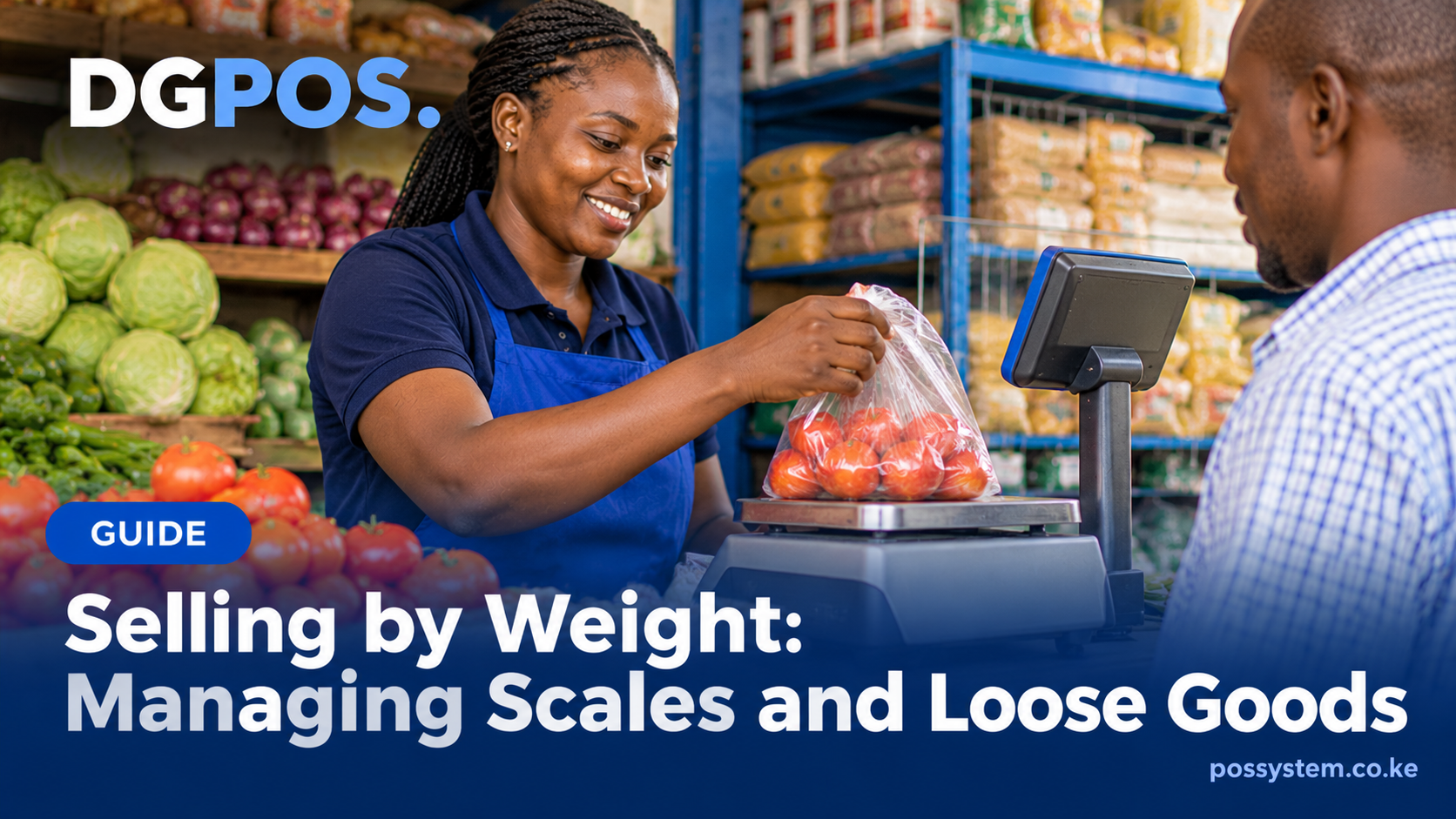
Selling products by weight is a common business practice in Kenya. From cereals and groceries to vegetables, fruits, meat, spices, animal feeds and hardware materials, many businesses rely on weighing scales to determine how much customers should pay. Although selling loose goods may appear simple, managing quantities, prices and sales records accurately requires proper systems and consistent procedures.
For shop owners, supermarkets, minimarts, market traders, butcheries, agrovets and wholesalers, even small weighing errors can lead to financial losses. Incorrect measurements, wrong price settings, poor stock records and manual calculation mistakes can affect profitability and customer trust. This is why businesses need reliable weighing equipment, clear pricing methods and an organised way of recording transactions.
A well-managed POS (Point Of Sale) process can make selling by weight easier by helping businesses maintain accurate sales records, calculate transaction amounts and monitor business performance. When supported by suitable pos software, a business can improve how it handles loose goods, track sales more consistently and reduce unnecessary paperwork.
This guide explains how to manage weighing scales and loose goods, calculate prices correctly, maintain stock records and use a suitable POS SYSTEM to improve daily business operations.
1. Understanding Selling by Weight
Selling by weight means charging customers according to the measured quantity of a product rather than selling it at a fixed price per item or package. The customer pays based on the weight recorded by the weighing scale and the price assigned to each kilogram, gram or other measurement unit.
For example, a cereal shop may sell rice at KSh 180 per kilogram. A customer purchasing 2.5 kilograms should pay KSh 450.
The calculation is:
Total price = Weight × Price per unit
Businesses that sell by weight commonly deal with:
- Rice, beans, green grams and maize
- Sugar, flour and other dry food products
- Potatoes, onions, tomatoes and other vegetables
- Fruits sold per kilogram
- Meat, fish and poultry
- Animal feeds and agricultural products
- Nuts, spices and cooking ingredients
- Selected hardware and construction materials
Unlike businesses that sell only packaged products, shops dealing with loose goods must pay close attention to weighing accuracy, unit prices and the quantities sold.
A reliable Point Of Sale process helps ensure that each transaction is calculated correctly and recorded properly.
2. Why Accurate Weighing Is Important
Accuracy is one of the most important requirements when selling loose goods. Customers expect to receive the quantity they have paid for, while business owners need to ensure that every sale reflects the correct product weight and selling price.
Incorrect weighing can create several problems.
Preventing Financial Losses
If a shop consistently gives customers more product than they pay for, the business loses money through unrecorded stock. Even a small difference per transaction can become significant when the shop serves many customers daily.
For example, a shop selling 100 kilograms of rice daily may experience substantial losses if its weighing process regularly provides extra quantities without charging for them.
Accurate measurements help protect profit margins and improve stock control.
Maintaining Customer Trust
Customers are more likely to return to a business when they trust its measurements and prices. Transparent weighing practices demonstrate honesty and professionalism.
Allowing customers to see the scale reading and explaining the price calculation can help prevent disagreements.
Improving Stock Control
Every kilogram sold reduces the quantity available in the shop. When weighing records are inaccurate, the physical stock may not match the business records.
Using an organised point of sale system can help businesses maintain better sales information, provided the system is configured to record the correct products and measurement units.
Supporting Better Business Decisions
Accurate sales records help business owners identify fast-moving products, monitor revenue and understand customer purchasing patterns.
These records are useful when planning purchases, setting prices and managing available stock.
3. Choosing the Right Weighing Scale for Your Business
The type of weighing scale you choose should depend on the products you sell, the quantities handled and the level of accuracy required.
Not every business needs the same type of scale.
Digital Weighing Scales
Digital scales display measurements electronically and are commonly used in grocery shops, supermarkets, butcheries and market stalls.
Their advantages include:
- Easy-to-read weight displays
- Convenient measurements
- Faster weighing processes
- Support for different measurement units, depending on the model
- Easy operation for trained staff
Digital scales can make daily selling more efficient, especially in businesses that handle many transactions.
Price Computing Scales
Price computing scales can calculate the selling price based on the weight and unit price entered into the scale.
For example, if a customer purchases 1.5 kilograms of beans at KSh 160 per kilogram, the scale can calculate the total amount.
Depending on the model, some scales can store product prices and print labels or receipts.
These scales are particularly useful for supermarkets, butcheries and grocery businesses.
Platform Scales
Platform scales are designed for heavier products and larger quantities.
They may be suitable for:
- Wholesale cereal businesses
- Animal feed suppliers
- Agricultural produce dealers
- Hardware businesses
- Bulk goods distributors
When choosing a scale, consider its maximum capacity, minimum weighing increment, durability and suitability for your products.
Hanging Scales
Hanging scales are commonly used in some market environments and businesses handling products that can be suspended during weighing.
They can be useful where platform or counter scales are less practical.
Before purchasing any scale, confirm that it meets the applicable legal and measurement requirements for commercial use.
4. Understanding Weight Measurements and Pricing
A business that sells loose goods should establish consistent measurement and pricing procedures.
Common measurement units include:
- Kilograms (kg)
- Grams (g)
- Litres (L), where products are sold by volume rather than weight
- Tonnes for large commercial quantities
It is important not to confuse weight and volume. A kilogram measures mass, while a litre measures volume. They are not interchangeable unless a specific product conversion has been established.
Example of Selling by Kilogram
Suppose a grocery shop sells green grams at KSh 200 per kilogram.
| Weight purchased | Price per kilogram | Total amount |
|---|---|---|
| 0.5 kg | KSh 200 | KSh 100 |
| 1 kg | KSh 200 | KSh 200 |
| 1.5 kg | KSh 200 | KSh 300 |
| 2 kg | KSh 200 | KSh 400 |
| 2.5 kg | KSh 200 | KSh 500 |
The selling price should always be based on the actual measured quantity.
Example of Selling by Gram
Some businesses sell expensive products in smaller quantities, making grams a more practical measurement.
For example, if a product costs KSh 500 per kilogram:
- 1 kilogram costs KSh 500.
- 500 grams cost KSh 250.
- 250 grams cost KSh 125.
- 100 grams cost KSh 50.
A consistent pricing method reduces confusion and helps cashiers calculate amounts correctly.
A properly configured POS SYSTEM can support these calculations where the available software supports sales by weight and the required measurement units.
5. How to Calculate the Correct Selling Price
Calculating the correct selling price is essential for businesses dealing with loose goods.
The basic formula is:
Selling Amount = Measured Weight × Price Per Kilogram
For example:
- Product: Beans
- Weight: 3.5 kg
- Price per kilogram: KSh 150
Calculation:
3.5 × 150 = KSh 525
The customer should pay KSh 525.
However, businesses should also understand the relationship between buying costs, operating expenses and selling prices.
Consider the Cost of Purchasing Stock
Suppose a wholesaler sells a 50-kilogram bag of rice to your business for KSh 6,000.
The buying cost per kilogram is:
KSh 6,000 ÷ 50 = KSh 120 per kilogram.
If you sell the rice at KSh 150 per kilogram, the difference is KSh 30 per kilogram before other expenses and losses.
Your actual profit must also account for packaging, transport, storage, handling, wastage and other operating costs.
Review Prices Regularly
Wholesale prices may change due to supplier adjustments, transport costs, seasonal availability and market conditions.
Review your selling prices regularly to ensure that the business remains profitable.
Using pos software can help organise product prices and sales records, depending on the available functions and configuration.
6. Managing Tare Weight and Packaging Materials
One important issue when selling loose goods is tare weight.
Tare weight refers to the weight of the empty container, packaging or material used to hold a product.
For example, when selling flour in a plastic container, the customer should pay for the flour rather than the empty container.
If the container weighs 100 grams and the combined weight of the container and flour is 1.6 kilograms, the actual product weight is 1.5 kilograms.
Net Weight = Gross Weight − Tare Weight
Where:
- Gross weight is the combined weight of the product and container.
- Tare weight is the weight of the empty container.
- Net weight is the actual weight of the product.
Practical Tare Weight Management Tips
- Use clean and suitable weighing containers.
- Confirm that the scale has a working tare function.
- Reset the scale correctly before weighing another product.
- Train employees on how to subtract packaging weight.
- Avoid using damaged or unsuitable containers.
- Check that the displayed measurement represents the actual product quantity.
Proper tare weight management protects customers from overcharging and helps the business maintain accurate measurements.
7. How to Manage Loose Goods Inventory
Loose goods require careful inventory management because products are continuously divided into smaller quantities during sales.
A shop may purchase a 50-kilogram bag of maize flour and sell it in quantities of 1 kilogram, 2 kilograms or 500 grams. Every transaction reduces the available stock.
Without proper records, it becomes difficult to know how much stock remains.
Record All Stock Purchases
Whenever new stock arrives, record:
- Product name
- Quantity received
- Measurement unit
- Purchase price
- Supplier details
- Date received
- Any damaged or missing quantity
For example, when receiving 100 kilograms of beans, record the full quantity before making the stock available for sale.
Record Every Sale
Each sale should reduce the recorded stock by the quantity sold.
If a shop starts with 100 kilograms of rice and sells 2.5 kilograms, the remaining quantity should be 97.5 kilograms, assuming there are no other stock movements.
A suitable POS solution can make sales recording more organised, provided it supports the relevant quantity and measurement settings.
Monitor Damaged and Wasted Products
Loose goods may experience losses through:
- Spillage
- Moisture damage
- Pest infestation
- Contamination
- Expired or spoiled products
- Incorrect handling
Record these losses separately from customer sales. This makes it easier to understand why physical stock may differ from recorded stock.
Conduct Regular Stock Counts
Physical stock counts help confirm whether the recorded quantities match the actual goods available.
Businesses selling high-volume loose products may benefit from more frequent checks.
8. Setting Up a POS System for Weight-Based Sales
A point of sale system can help businesses organise sales transactions, product information and business records. However, when dealing with loose goods, the business must confirm that the selected system supports its specific weighing requirements.
A standard sales setup may not automatically support direct electronic scale integration.
Before adopting a POS SYSTEM, consider the following areas.
Product Setup
Create clear product records for every loose item.
For example:
| Product | Measurement unit | Selling price |
|---|---|---|
| Rice | Kilogram | KSh 180 |
| Beans | Kilogram | KSh 200 |
| Green grams | Kilogram | KSh 220 |
| Sugar | Kilogram | KSh 160 |
| Groundnuts | Kilogram | KSh 350 |
The prices above are examples only. Each business should enter its actual selling prices.
Measurement Settings
Confirm whether the software can record fractional quantities such as:
- 0.25 kg
- 0.5 kg
- 0.75 kg
- 1.25 kg
- 2.5 kg
This is important because customers do not always purchase whole kilograms.
Scale Integration
If you want the weighing scale to send measurements directly to your till, confirm whether the software supports your scale model and connection method.
Some businesses may need to enter the measured weight manually, while others may use compatible electronic equipment.
Do not assume that every POS SYSTEM can connect to every digital weighing scale.
Transaction Records
A good sales process should record the product, quantity, unit price and total amount.
These details help business owners review transactions and investigate pricing or stock discrepancies.
Receipt Information
Where the system supports detailed receipts, ensure that customers can understand what they purchased, the quantity and the amount charged.
Clear receipts can reduce misunderstandings and improve accountability.
9. Common Mistakes to Avoid When Selling Loose Goods
Even an experienced shop owner can make mistakes when managing weighing scales and loose products.
Here are common problems to watch out for.
Using Incorrect Scale Settings
A scale configured to display grams when the cashier expects kilograms can cause serious pricing errors.
Always confirm the measurement unit before weighing products.
Failing to Zero the Scale
A scale that does not start from zero may provide inaccurate readings.
Check the zero reading before weighing products, following the manufacturer’s instructions.
Ignoring Tare Weight
Charging customers for the weight of packaging materials can create customer complaints and damage trust.
Train employees to use the tare function correctly.
Entering the Wrong Product Price
If the cashier selects the wrong product or uses an outdated price, the customer may be charged incorrectly.
Maintain clear product names and review prices whenever supplier costs change.
Recording Sales Manually Without Checking Calculations
Manual calculations can lead to errors, particularly when handling many small transactions.
A suitable Point Of Sale process can help standardise calculations and record transactions more consistently.
Failing to Update Stock
When sales are not recorded correctly, the business may believe it has more stock than it actually does.
Ensure every sale and stock adjustment is recorded.
Ignoring Scale Maintenance
Dust, product residue, moisture and physical damage can affect weighing equipment.
Clean and maintain scales according to the manufacturer’s instructions.
10. Training Employees to Handle Weighing Scales
Employees play an important role in ensuring that weight-based sales are accurate.
Even when a business has reliable equipment and a modern POS SYSTEM, poorly trained employees can still make mistakes.
Staff should understand:
- How to switch on and operate the weighing scale.
- How to select the correct measurement unit.
- How to check whether the scale is reading zero.
- How to use the tare function.
- How to calculate the price of a measured quantity.
- How to select the correct product on the till.
- How to record sales accurately.
- How to identify damaged or faulty equipment.
- How to report weighing discrepancies.
- How to handle customer questions about measurements.
Business owners should also establish clear procedures for correcting mistakes and reporting unusual transactions.
Regular training helps maintain consistent service even when employees change shifts.
11. Maintaining and Checking Your Weighing Scales
Weighing equipment should be checked regularly to ensure it remains accurate and suitable for commercial use.
An inaccurate scale can lead to customer disputes, financial losses and regulatory problems.
Daily Checks
Before starting business operations:
- Check that the scale switches on properly.
- Confirm that the display is readable.
- Ensure the weighing surface is clean.
- Check that the scale reads zero when empty.
- Inspect cables and power connections where applicable.
- Confirm that the correct measurement unit is selected.
Routine Maintenance
Follow the manufacturer’s recommended maintenance schedule.
Avoid exposing weighing equipment to excessive moisture, unnecessary impact or unsuitable cleaning chemicals.
Verification and Legal Requirements
Businesses using weighing instruments for commercial transactions in Kenya should confirm the applicable requirements with the relevant Weights and Measures authorities.
Use instruments that meet applicable legal requirements and ensure any required verification, inspection or certification remains valid.
Do not rely only on a scale appearing to work correctly. Commercial weighing accuracy must be properly maintained.
12. How POS Software Can Improve Loose Goods Management
As a business grows, managing loose goods using notebooks, calculators and handwritten stock records becomes increasingly difficult.
A suitable pos software solution can help organise business information and reduce dependence on scattered manual records.
Depending on its available features, configuration and equipment compatibility, a point of sale system may help with the following:
Organised Product Records
Businesses can maintain product names, selling prices and other relevant information in one organised location.
This helps cashiers identify products and apply the correct prices.
Better Sales Tracking
Recording transactions electronically can make it easier to review how much of each product has been sold.
For example, a grocery owner can review recorded rice, beans and sugar sales over a selected period if the software provides suitable reporting.
Improved Stock Monitoring
Where inventory management is supported, recorded sales can help update stock quantities and highlight products that may need restocking.
Easier Business Reporting
Sales reports can help owners understand daily performance, compare product sales and identify changes in customer demand.
Improved Accountability
Individual transaction records can help business owners review sales activity and investigate discrepancies.
Reduced Manual Work
A properly configured POS SYSTEM can reduce repetitive calculations and paperwork, allowing employees to focus more on serving customers.
For businesses considering DGPOS from Digee Technologies Limited, it is useful to explore the available product functions and confirm whether the required weight-based selling, fractional quantity entry, inventory tracking and weighing-scale integration are supported.
13. Best Practices for Managing Different Types of Loose Goods
Different products require different handling and storage procedures.
A business should establish product-specific processes to maintain quality, accurate measurements and reliable stock records.
Cereals and Grains
Examples include rice, beans, maize, millet and green grams.
Best practices:
- Store products in clean, dry containers.
- Protect them from moisture and pests.
- Use appropriate scoops and weighing equipment.
- Keep different varieties clearly labelled.
- Record purchases and sales using consistent measurement units.
Vegetables and Fruits
Examples include potatoes, onions, tomatoes, oranges and bananas.
Best practices:
- Separate damaged produce from fresh stock.
- Monitor spoilage regularly.
- Keep weighing areas clean.
- Avoid mixing different product varieties when pricing differs.
- Record wastage to understand stock losses.
Meat and Fish
These products require careful hygiene and temperature control.
Best practices:
- Use suitable food-safe weighing equipment.
- Clean weighing surfaces regularly.
- Follow appropriate food-handling practices.
- Prevent cross-contamination.
- Ensure packaging weight is excluded where applicable.
Animal Feeds
Agrovets and animal feed businesses often sell products in different quantities.
Best practices:
- Store feed in dry and secure conditions.
- Keep product labels visible.
- Record quantities received and sold.
- Monitor packaging damage.
- Use consistent measurement units.
Spices and Small-Quantity Products
Products such as cloves, pepper, turmeric and other spices may be sold in small quantities.
Best practices:
- Use scales suitable for small measurements.
- Check the scale’s minimum weighing capacity.
- Avoid mixing products.
- Use clean containers.
- Display prices clearly.
A suitable POS process can help maintain consistent product and sales records across these different categories.
14. How to Improve Customer Confidence When Selling by Weight
Customer confidence is important for any business that sells loose goods.
Customers should feel comfortable knowing that they are receiving the correct quantity and paying the right amount.
Consider these practices:
- Position the weighing scale where customers can see the reading.
- Display prices per kilogram clearly.
- Explain calculations when customers ask questions.
- Use clean and suitable weighing containers.
- Ensure scales are properly maintained.
- Provide receipts where available.
- Train employees to communicate politely.
- Correct weighing or pricing errors promptly.
Transparency helps create a positive shopping experience and encourages repeat purchases.
When sales are recorded through a Point Of Sale solution, businesses can also improve transaction organisation and provide clearer sales information.
15. How to Choose the Right POS System for a Business Selling by Weight
Not every retail business has the same requirements. A minimart selling cereals may need different weighing and stock management functions from a supermarket, butchery or agricultural wholesaler.
Before choosing a point of sale system, identify the functions that matter most to your operations.
Important Questions to Ask
1. Can the system record decimal quantities?
Confirm whether it can handle quantities such as 0.25 kg, 0.5 kg and 1.75 kg.
2. Can it support different measurement units?
Check whether the system can handle kilograms, grams and other relevant units.
3. Does it support weighing-scale integration?
If you want direct communication between your scale and the till, confirm the supported models and connection requirements.
4. Can it manage loose goods as inventory items?
Find out whether the software can record stock purchases, sales and adjustments using the appropriate units.
5. Can it produce sales reports?
Ask whether you can review product quantities sold, revenue and other relevant business information.
6. Can employees use it easily?
A system should be practical for the people who will operate it every day.
7. What support is available?
Understand how technical assistance, training and system updates are handled.
8. What are the total costs?
Consider software charges, hardware, installation, training, maintenance and any additional equipment required.
A business should choose a POS SYSTEM based on its actual needs rather than selecting one simply because it has many advertised features.
16. Practical Daily Checklist for Selling by Weight
Use this checklist to maintain consistent weighing and sales procedures.
Before Opening
- Switch on and inspect weighing scales.
- Confirm that the scale reads zero.
- Check the measurement unit.
- Clean weighing surfaces.
- Confirm product prices.
- Check available stock.
- Ensure the till or POS system is ready.
During Business Hours
- Weigh every product accurately.
- Apply the correct tare weight.
- Confirm the correct product price.
- Record every sale.
- Issue receipts where applicable.
- Monitor damaged or wasted goods.
- Keep the weighing area clean.
At Closing Time
- Review recorded sales.
- Compare selected physical stock quantities with recorded stock.
- Investigate unusual differences.
- Record wastage and stock adjustments.
- Review daily sales performance.
- Prepare a restocking list.
Following a consistent checklist makes it easier to identify problems before they become major business losses.
17. Why Digee Technologies Limited Is Relevant to Modern Retail Management
Digee Technologies Limited provides technology solutions for businesses looking to improve their daily operations. Through DGPOS, businesses can explore a more organised approach to managing sales and business information.
For retailers selling cereals, groceries, vegetables, animal feeds and other loose goods, digital sales management can be an important step towards improving transaction records and business visibility.
Before adopting any POS SYSTEM, businesses should identify the exact weighing and inventory functions they require and confirm their availability with the provider.
DGPOS can be explored as an option for businesses looking to modernise their sales management processes. Businesses should discuss their specific requirements with Digee Technologies Limited, especially where decimal quantities, multiple measurement units, stock management or direct scale integration are essential.
Visit https://digeetechnologies.com/ to learn more about Digee Technologies Limited and its technology solutions.
Conclusion
Selling by weight requires more than having a weighing scale at the counter. Businesses must maintain accurate measurements, apply correct prices, manage tare weight, record sales and monitor stock quantities consistently.
Whether you operate a minimart, supermarket, grocery shop, butchery, agrovet or wholesale business, proper weighing procedures can reduce errors, protect profits and improve customer confidence.
Combining reliable weighing equipment with organised sales records and suitable pos software can make loose goods management easier. A well-selected point of sale system can also help business owners improve transaction tracking and gain better visibility into daily operations.
For businesses planning to upgrade their operations, choosing the right POS SYSTEM starts with understanding their products, weighing requirements and stock management needs.
With proper equipment, trained employees and consistent procedures, selling by weight can become a more accurate, transparent and manageable part of running a successful business.
Frequently Asked Questions (FAQs)
1. What is selling by weight?
Selling by weight means charging customers according to the measured quantity of a product. The price is calculated using the product’s weight and the selling price per measurement unit.
2. Which businesses commonly sell products by weight?
Common examples include supermarkets, minimarts, grocery shops, butcheries, cereal shops, agrovets, fruit vendors, spice shops and wholesale businesses.
3. How do I calculate the price of loose goods?
Multiply the measured weight by the price per kilogram or other applicable unit. For example, 2 kilograms of beans at KSh 150 per kilogram cost KSh 300.
4. What is tare weight?
Tare weight is the weight of an empty container or packaging material. It is deducted from the combined weight to determine the actual weight of the product.
5. Can a POS system manage products sold by weight?
Some systems support weight-based sales and fractional quantities, but capabilities differ. Confirm whether the selected POS SYSTEM supports your measurement units, decimal quantities and weighing equipment.
6. Can digital weighing scales connect to POS software?
Some weighing scales can connect to compatible pos software, depending on the scale model, communication interface and software configuration. Always confirm compatibility before purchasing equipment.
7. Why is stock tracking important for loose goods?
Stock tracking helps businesses monitor quantities received, quantities sold and remaining stock. It also helps identify wastage, damage and unexplained inventory differences.
8. How often should weighing scales be checked?
Scales should be checked before use and maintained according to the manufacturer’s instructions. Businesses should also comply with applicable commercial weighing verification and inspection requirements.
9. Can a point of sale system reduce weighing errors?
A suitable point of sale system can help standardise price calculations and transaction records. However, accurate results still depend on correct scale readings, proper settings and employee training.
10. What should I consider before buying a POS system for loose goods?
Consider decimal quantity support, measurement units, inventory management, scale compatibility, sales reporting, ease of use, technical support and total operating costs.
11. Is a POS system useful for a small cereal shop?
Yes. A suitable Point Of Sale solution can help a small cereal shop organise product records, sales transactions and business information. The business should confirm that the system supports its specific weight-based selling requirements.
12. Where can I learn more about DGPOS?
You can visit Digee Technologies Limited at http://possystem.co.ke/to learn more about DGPOS and explore available business technology solutions.