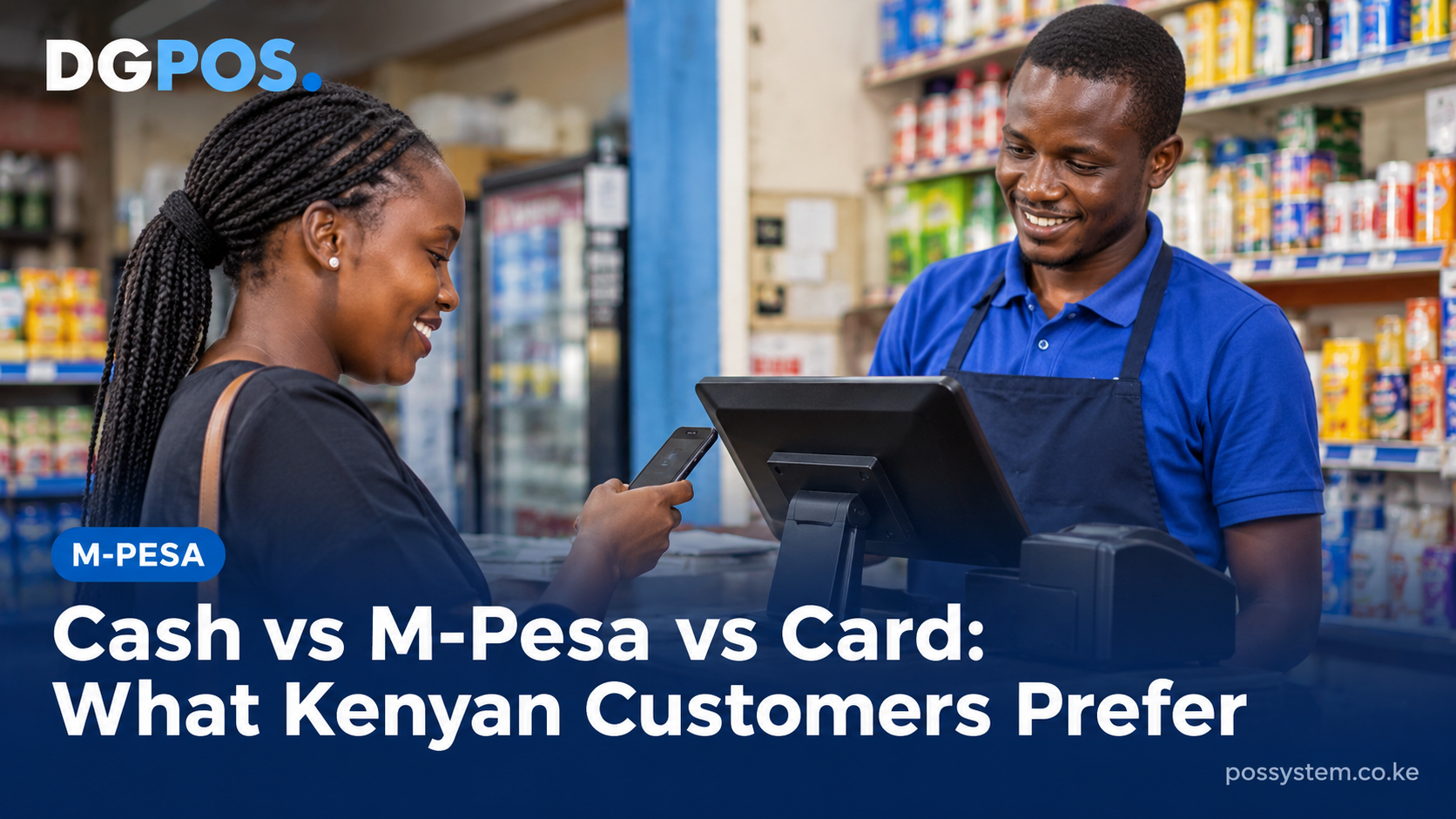
The way customers pay for goods and services in Kenya has changed significantly over the years. Traditionally, cash was the most common payment method in shops, supermarkets, restaurants, pharmacies, hotels, and other businesses. Today, however, customers have more payment options, including M-Pesa, debit cards, and credit cards. Understanding Cash vs M-Pesa vs Card: What Kenyan Customers Prefer is important for every business owner who wants to improve customer experience, increase sales, reduce payment delays, and manage daily transactions efficiently. Kenyan customers have different payment preferences depending on their age, location, shopping habits, transaction amount, convenience, and access to financial services. Some customers still prefer cash because it is familiar and easy to use, while others prefer M-Pesa because of its speed and convenience. Card payments are also important, particularly in supermarkets, hotels, restaurants, shopping centres, and businesses serving customers who prefer electronic payments. For business owners, accepting different payment methods is no longer simply an added advantage; it is an important part of providing convenient customer service. A modern POS SYSTEM helps businesses manage sales regardless of whether customers pay using cash, M-Pesa, or cards. With reliable pos software, business owners can record transactions, monitor sales, reconcile payments, and understand which payment methods customers use most frequently. A well-configured Point Of Sale solution can also help businesses reduce manual recording errors and improve the accuracy of financial reports. This guide explores cash, M-Pesa, and card payments in Kenya, explains what customers prefer, examines the advantages and disadvantages of each payment method, and shows how a reliable point of sale system can help businesses manage multiple payment options more effectively.
Understanding Payment Preferences Among Kenyan Customers
Customer payment preferences are influenced by convenience, accessibility, security, transaction costs, and personal habits. A customer buying groceries from a local shop may prefer cash, while someone purchasing expensive electronics may choose M-Pesa or a card. Similarly, customers visiting a restaurant may use M-Pesa to settle their bills, while others may prefer paying with cash or tapping their cards at the counter. This means that businesses should avoid assuming that all customers prefer the same payment method. Understanding Cash vs M-Pesa vs Card: What Kenyan Customers Prefer requires looking at the different circumstances that influence payment decisions. Cash remains familiar and useful, especially for smaller transactions. M-Pesa has become an important payment option because customers can pay directly from their mobile phones without carrying physical money. Card payments offer another convenient option, particularly for customers who regularly use banking services. Businesses that accept several payment methods are better positioned to serve different customer groups. A flexible POS SYSTEM allows staff to select the appropriate payment method when recording a transaction, making it easier to manage different types of sales. With suitable pos software, a business can also review payment records and identify which methods are commonly used during different periods.
1. Cash Payments in Kenya
Cash remains an important payment method in the Kenyan business environment. Despite the growth of digital payments, many customers continue to use physical money when purchasing everyday products and services. Cash is particularly common in small retail shops, kiosks, market stalls, local food businesses, transport-related businesses, and informal trading environments. Customers who prefer cash often appreciate its simplicity because they can pay immediately without needing a mobile phone, internet connection, bank account, or payment application. For small transactions, cash can also feel straightforward because the customer can see exactly how much money they are spending. Businesses that serve customers from different economic backgrounds should therefore continue to recognise the importance of cash. However, handling cash manually can create challenges for business owners. Staff members must count money, calculate change, keep records, and ensure that the cash received matches the sales recorded. Mistakes can happen when employees are busy, especially during peak shopping hours. Cash can also be lost, misplaced, stolen, or incorrectly recorded. A reliable Point Of Sale solution can help reduce these challenges by recording each cash transaction and including it in the daily sales report. Instead of depending entirely on handwritten records, businesses can use POS technology to maintain more organised transaction information.
Advantages of Accepting Cash
One major advantage of cash is accessibility. Customers do not need a smartphone, mobile payment account, or bank card to complete a purchase. This makes cash useful for businesses serving customers with different levels of access to digital financial services. Cash payments are also straightforward for small purchases, particularly where customers already have the required amount available. Another advantage is that cash transactions do not depend on mobile network availability or digital payment confirmation systems. When mobile services experience interruptions, cash can provide an alternative way for businesses to continue serving customers. Cash also gives business owners immediate physical access to the money received, although the business must still manage deposits, security, and cash handling responsibly. A well-designed point of sales system can record cash sales alongside electronic payments, giving managers a clearer picture of total revenue. This is particularly useful for supermarkets and shops where several cashiers handle transactions throughout the day.
Challenges of Cash Payments
Although cash is convenient, it comes with several disadvantages. Counting large amounts of money can consume time, especially when a business handles many customers every day. Employees may give incorrect change, forget to record transactions, or make mistakes when calculating totals. Cash handling also increases the responsibility of securing money at the business premises. Businesses may experience discrepancies between recorded sales and the actual cash available in the till. These problems can make it difficult to understand the true financial position of a business. Manual cash records are also challenging to analyse because managers may need to calculate totals from handwritten books. Using pos software can make cash management easier by recording every transaction and generating reports that help managers compare expected cash sales with the cash collected. A modern POS SYSTEM can therefore support accountability and improve the accuracy of daily business operations.
2. M-Pesa Payments in Kenya
M-Pesa has transformed how many Kenyans send and receive money. Customers can use their mobile phones to pay for products, settle bills, and transfer money without carrying physical cash. For many businesses, M-Pesa has become one of the most important payment methods because it offers convenience to customers who prefer digital transactions. Customers can pay from their phones while shopping in supermarkets, restaurants, pharmacies, hardware shops, clothing stores, and other businesses. M-Pesa is especially useful when customers do not have enough cash available or prefer not to withdraw money before making a purchase. The popularity of mobile payments has also encouraged businesses to provide clear payment instructions at their counters. However, accepting M-Pesa requires proper transaction verification and record management. Businesses should not rely only on screenshots or customer messages as proof of payment. Staff should confirm payments through the appropriate official business payment channel before completing a transaction. A suitable point of sale system can help businesses record M-Pesa transactions and associate payments with individual sales, depending on the system’s supported payment integrations and configuration. This makes it easier to understand how much revenue came from mobile payments and compare it with cash and card transactions.
Why Many Kenyan Customers Prefer M-Pesa
Convenience is one of the main reasons customers choose M-Pesa. A customer can complete a payment using a mobile phone without needing to carry physical money. This is particularly helpful for customers who regularly make digital transactions or prefer keeping less cash in their wallets. M-Pesa is also familiar to many Kenyan consumers, making it an accessible payment option across different types of businesses. Another advantage is that mobile payments create electronic transaction records. Customers can receive payment confirmations, while businesses using appropriate payment channels can access transaction information for verification and reconciliation. M-Pesa is also useful for customers making purchases when they do not have exact cash available. Instead of searching for smaller denominations, they can pay the required amount electronically. For businesses, supporting M-Pesa can improve customer convenience and reduce the need to handle large amounts of physical cash. Integrating M-Pesa records into a properly configured POS SYSTEM can make it easier to track sales and organise financial information.
Challenges of M-Pesa Payments
Although M-Pesa offers many advantages, businesses must understand its limitations. Network interruptions, delayed confirmations, incorrect payment details, and transaction failures can affect the payment process. Employees must verify that the correct amount has been received before releasing goods or marking a sale as paid. One common problem is fake payment confirmation messages. Fraudsters may send edited screenshots or misleading messages to convince staff that a payment has been completed. Businesses should always verify transactions using official payment confirmation channels rather than relying entirely on information displayed on a customer’s phone. Another challenge is reconciling mobile payments with sales records. When a business receives many M-Pesa transactions, matching each payment to the correct customer purchase can become difficult if records are maintained manually. A reliable pos software solution can help organise sales information and support reconciliation where the relevant integration is available. A good Point Of Sale process should ensure that every mobile payment is linked to the correct transaction.
3. Card Payments in Kenya
Card payments provide another convenient way for customers to pay for goods and services. Customers can use debit cards or credit cards issued by banks and other authorised financial institutions. Depending on the payment terminal and supported technology, transactions may be completed through chip-and-PIN, contactless tapping, or other approved methods. Card payments are commonly useful in supermarkets, hotels, restaurants, larger retail outlets, shopping centres, and businesses that serve customers who prefer banking cards. They are also important for businesses that receive visitors who may be more comfortable using cards than cash or mobile money. For customers, card payments reduce the need to carry physical cash. They can also make it easier to complete higher-value purchases, depending on their available balance, credit limit, and bank restrictions. For businesses, accepting cards creates another payment option and can improve convenience at the checkout counter. A modern POS SYSTEM can help record card sales alongside other transactions, depending on the connection between the payment terminal and the business management software. This gives business owners a more complete view of their daily revenue.
Advantages of Card Payments
One advantage of card payments is convenience. Customers can pay without carrying large amounts of cash, making cards useful for purchases in established retail businesses. Card transactions also produce electronic records that can support accounting and financial reconciliation. Businesses can use these records to compare sales with settlement reports from their payment providers. Card payments may also improve the checkout experience for customers who are comfortable using contactless or chip-based payment methods. For businesses serving different customer groups, accepting cards can increase payment flexibility. A point of sale system can make it easier to include card transactions in daily reports, helping managers understand total sales across all payment methods. With suitable pos software, businesses can organise transaction information, review sales performance, and maintain more consistent financial records.
Challenges of Card Payments
Card payments also come with certain challenges. Businesses may need payment terminals, merchant accounts, and arrangements with payment service providers before accepting card transactions. Depending on the provider and transaction type, businesses may also incur processing fees or other charges. Another challenge is that transactions can fail because of insufficient funds, bank restrictions, technical problems, or communication interruptions. Employees must confirm successful payment before completing the sale. Card settlement may also follow a different timeline from cash received at the counter. This means business owners should understand how their payment provider handles settlements and reporting. A well-configured POS SYSTEM can help record the sale, while payment provider reports can be used to verify the actual settlement. Keeping these records organised is important for accurate bookkeeping and financial management.
Cash vs M-Pesa vs Card: What Are the Main Differences?
When comparing cash, M-Pesa, and card payments, businesses should consider convenience, accessibility, transaction verification, record keeping, and customer preferences. Each method serves a different purpose, and none should automatically be considered the best option for every business.
| Feature | Cash | M-Pesa | Card |
|---|---|---|---|
| Payment method | Physical money | Mobile money | Debit or credit card |
| Requires a smartphone | No | Usually requires a mobile phone | No smartphone required |
| Requires a bank account | No | Not necessarily a traditional bank account | Usually linked to a financial account |
| Electronic transaction record | Not automatically | Yes, through payment records | Yes, through payment records |
| Network dependency | No | Yes, for normal electronic transactions | Usually yes |
| Physical cash handling | Yes | No | No |
| Payment verification | Count the money | Confirm through official channels | Confirm through the payment terminal or provider |
| Common business challenge | Counting and cash security | Fake confirmations and reconciliation | Processing fees and failed transactions |
The best payment method depends on the customer’s situation and the business’s operational needs. Cash can be suitable for small purchases, M-Pesa offers mobile convenience, and cards provide an alternative for customers who prefer banking-based payments. A flexible Point Of Sale solution helps businesses record all three methods without depending on separate manual systems.
4. What Kenyan Customers Prefer When Shopping
Customer preferences vary depending on the type of business, location, customer demographics, transaction value, and shopping environment. A business operating in a busy urban shopping centre may serve customers who regularly use M-Pesa and cards. A small neighbourhood shop may receive many cash payments while also accepting mobile money. A restaurant may handle a mixture of cash, M-Pesa, and card payments depending on the customer. Therefore, understanding Cash vs M-Pesa vs Card: What Kenyan Customers Prefer requires businesses to study their actual customers rather than relying on assumptions.
Customers in Small Retail Shops
Customers shopping in small retail shops may use cash or M-Pesa depending on the amount they are spending and their preferred payment habits. Some customers prefer cash for small purchases because it is quick and familiar. Others prefer M-Pesa because they do not need to carry physical money. Retailers should make both options available where practical. A POS SYSTEM can help shop owners record each sale and identify how much revenue comes from cash and mobile payments.
Supermarket Customers
Supermarkets often serve customers with different payment preferences. Some shoppers pay using cash, others use M-Pesa, and some prefer debit or credit cards. During busy shopping periods, offering several payment methods can help reduce situations where customers cannot complete purchases because their preferred option is unavailable. Supermarkets can benefit from a reliable point of sale system that records transactions, supports checkout operations, and generates reports showing sales by payment method.
Restaurant and Hotel Customers
Restaurants and hotels may receive payments through all three methods. Customers ordering meals may prefer M-Pesa for convenience, while others may use cash or cards. Businesses in the hospitality sector should make payment options clear and ensure staff know how to verify transactions. A suitable pos software solution can help record bills, track payments, and maintain accurate daily sales reports, depending on the system’s capabilities.
Pharmacy Customers
Pharmacy customers may prefer different payment options depending on their purchases and personal circumstances. Some may use M-Pesa for convenience, while others may pay by cash or card. Pharmacies should ensure that payment records are correctly associated with the relevant sales. A Point Of Sale solution can support transaction management while helping the business maintain organised sales information.
Hardware and Building Material Customers
Hardware shops may handle both small retail purchases and large orders. A customer purchasing a few tools may pay in cash or through M-Pesa, while someone buying materials for a construction project may prefer an electronic payment method. Because transactions can involve substantial amounts, businesses should pay particular attention to payment verification. A well-configured POS SYSTEM can help record different payment types and support better transaction tracking.
5. Why Businesses Should Accept Cash, M-Pesa, and Card Payments
Businesses should consider offering several payment methods because customers value flexibility. A customer who prefers M-Pesa may choose another shop if the business only accepts cash. Similarly, a customer who wants to pay using a card may experience inconvenience if card payments are unavailable. Offering different payment options helps businesses serve a wider range of customers and reduce unnecessary barriers during checkout. Payment flexibility can also support customer satisfaction because people can choose the method that works best for them. From an operational perspective, accepting multiple payment methods gives business owners more information about customer behaviour. A point of sale system can help record sales according to payment type, making it easier to review transaction patterns. For example, a supermarket owner may discover that M-Pesa transactions increase during certain periods, while cash remains common for smaller purchases. A restaurant may find that card payments are more common among particular customer groups. This information can help managers plan checkout operations and improve customer service. With reliable pos software, the business can maintain organised transaction records instead of relying on separate handwritten payment books.
6. How a POS System Helps Manage Cash, M-Pesa, and Card Payments
Managing different payment methods manually can become complicated as a business grows. Employees may handle hundreds of transactions every day, making it difficult to maintain accurate records using notebooks or spreadsheets alone. A modern POS SYSTEM provides a central platform for recording sales and organising payment information. When a cashier completes a sale, the appropriate payment method can be selected and recorded within the system. This helps managers understand how customers are paying and how much revenue is generated through each method. A reliable Point Of Sale solution can support several important business operations.
Recording Transactions by Payment Method
A business needs accurate records of cash, M-Pesa, and card payments. Recording each transaction under the correct payment method makes it easier to prepare daily reports and identify discrepancies. A point of sales system can help employees record sales consistently, reducing dependence on handwritten transaction records.
Improving Daily Sales Reconciliation
Sales reconciliation involves comparing recorded transactions with the actual payments received or reported by payment providers. For cash, managers can compare expected cash sales with the money counted in the till. For M-Pesa, they can compare sales records with official transaction statements. For card payments, they can compare sales records with payment terminal and provider reports. A suitable pos software solution helps organise the sales side of this process, although external payment reports may still be needed to confirm settlements.
Reducing Manual Errors
Manual recording can result in incorrect totals, missing transactions, and duplicate entries. A properly configured POS SYSTEM helps standardise how sales are recorded. Employees can select the payment method and allow the system to calculate the transaction total. This can reduce common recording mistakes and improve consistency.
Generating Sales Reports
Sales reports help business owners understand how their operations are performing. Reports showing payment methods can reveal whether customers mostly use cash, M-Pesa, or cards. Managers can use this information to review payment trends and make operational decisions. A modern point of sale system can make it easier to access sales information without manually calculating every transaction.
Supporting Better Staff Accountability
When several employees handle payments, managers need clear transaction records. A Point Of Sale solution can help show which transactions were recorded and when they occurred, depending on the system’s user management and reporting features. This supports better accountability and makes it easier to investigate discrepancies.
Making Checkout More Organised
Customers expect a convenient checkout experience. Employees should know how to record cash payments, verify M-Pesa transactions, and confirm card payments correctly. A reliable POS SYSTEM can provide a more organised process by keeping sales information in one system. This is particularly important for supermarkets, restaurants, pharmacies, and busy retail shops.
7. How to Choose the Right Payment Methods for Your Business
Choosing the right payment options requires understanding the type of customers a business serves. A small shop may prioritise cash and M-Pesa, while a supermarket may benefit from supporting cash, M-Pesa, and cards. A hotel or restaurant may need several payment options to serve different customers conveniently. Business owners should consider the following factors before deciding which methods to support.
Understand your customers: Find out how your customers prefer to pay. Observe the methods they commonly request and consider asking for feedback. Do not assume that customer preferences are identical across all locations or business categories.
Consider transaction sizes: Small transactions may frequently involve cash or mobile payments, while larger purchases may require additional payment options. Understanding your average transaction value can help determine which methods are important.
Evaluate transaction costs: Payment providers may charge different fees depending on the service and transaction type. Compare the applicable costs and understand how they affect your business.
Check payment reliability: Consider the reliability of the services you plan to accept. Make sure staff know what to do when a payment fails or confirmation is delayed.
Train your employees: Employees should understand how to handle cash, verify M-Pesa payments, and confirm card transactions. Proper training helps reduce mistakes and protect the business from fraudulent payment claims.
Use reliable business technology: A suitable POS SYSTEM can help manage sales and payment records. Before choosing pos software, confirm that it supports the payment recording and reporting features your business needs.
8. Common Payment Mistakes Kenyan Businesses Should Avoid
Even when a business accepts several payment methods, poor payment management can lead to financial losses and customer dissatisfaction. Business owners should establish clear procedures for every transaction.
One common mistake is releasing goods before confirming that an electronic payment has been completed. Employees should always verify M-Pesa and card payments through the appropriate official channels. Another mistake is recording a payment under the wrong method. For example, recording an M-Pesa payment as cash can create reconciliation problems at the end of the day. Businesses should also avoid depending entirely on screenshots as proof of payment. Screenshots can be edited, so staff must verify transactions using official payment records.
Failing to reconcile daily sales is another serious problem. Business owners should regularly compare recorded cash sales with physical cash, M-Pesa sales with transaction statements, and card sales with provider records. A reliable point of sale system can help organise these records, but proper management procedures are still necessary.
Some businesses also fail to train employees on payment handling. Staff should know how to identify successful transactions, handle failed payments, issue receipts, and report suspicious activity. Finally, businesses should avoid relying on outdated manual records when transaction volumes become too high. Using a modern POS SYSTEM can make sales tracking more consistent and improve financial visibility.
9. The Future of Digital Payments in Kenya
Digital payments continue to influence how Kenyan businesses operate. Mobile money, card transactions, online payments, and other electronic payment solutions are becoming important parts of the customer experience. As more businesses adopt digital tools, customers increasingly expect convenient payment options when shopping. However, this does not mean cash will disappear completely. Different customers have different needs, and cash remains useful in many everyday transactions. The future of Cash vs M-Pesa vs Card: What Kenyan Customers Prefer is likely to involve businesses supporting a combination of payment methods rather than depending on only one option.
Business technology will also continue to play an important role. A modern Point Of Sale solution can help businesses manage transactions, monitor sales, and improve operational efficiency. As businesses expand, organised pos software can support better reporting and help managers understand customer payment behaviour. The importance of a reliable point of sale system will therefore continue to grow as businesses seek better ways to manage daily sales and financial information.
10. Why Digee Technologies Limited Company Is Important for Modern Business Management
Digee Technologies Limited Company understands the importance of organised business operations and reliable technology for Kenyan businesses. Whether you operate a supermarket, minimart, pharmacy, restaurant, hardware shop, clothing store, wholesale business, or another retail establishment, managing daily sales accurately is essential. Businesses need to know what they sell, how customers pay, and how much revenue they generate. A reliable POS SYSTEM can help simplify these responsibilities by bringing important sales information into one organised platform.
With suitable pos software, business owners can improve transaction recording, monitor business performance, and access useful sales information. A modern Point Of Sale solution can also help employees process transactions more consistently and reduce the challenges associated with manual record keeping. For businesses accepting cash, M-Pesa, and card payments, having organised transaction records is particularly important.
Digee Technologies Limited Company focuses on helping businesses embrace technology that supports efficient daily operations. A suitable point of sale system can help business owners manage sales more effectively, maintain organised records, and make informed decisions. Instead of depending entirely on handwritten books and manual calculations, businesses can use POS technology to improve visibility into their operations.
When comparing Cash vs M-Pesa vs Card: What Kenyan Customers Prefer, business owners should remember that customer convenience is important. Providing multiple payment options and managing them through an organised business system can help create a better shopping experience. Choosing suitable POS SYSTEM technology is an important step towards improving how a business handles transactions and monitors its performance.
Frequently Asked Questions (FAQs)
1. Which payment method is most popular in Kenya: cash, M-Pesa, or card?
Payment preferences vary depending on the customer, business type, location, and transaction amount. M-Pesa is widely used for everyday digital payments, while cash remains important for many purchases. Card payments are also useful in supermarkets, hotels, restaurants, and other businesses. Businesses should study their own transaction records rather than assume that one method is preferred by everyone.
2. Should Kenyan businesses accept all three payment methods?
Where practical, accepting cash, M-Pesa, and cards can help businesses serve customers with different preferences. The best combination depends on the business’s size, customer base, payment provider costs, and operational requirements.
3. Why do many customers prefer M-Pesa?
Many customers prefer M-Pesa because it allows them to pay using their mobile phones without carrying physical cash. It also provides electronic transaction records that can support payment verification.
4. Are cash payments still important for Kenyan businesses?
Yes. Cash remains useful because it does not require a mobile network, smartphone, or banking card. Many customers continue to prefer cash, particularly for smaller everyday purchases.
5. What are the advantages of card payments?
Card payments provide convenience for customers who prefer using debit or credit cards. They also generate electronic transaction records that can support financial reconciliation and business reporting.
6. How can a POS SYSTEM help manage different payment methods?
A POS SYSTEM can record sales according to the selected payment method, helping business owners organise cash, M-Pesa, and card transactions. Depending on its configuration and integrations, it may also support additional payment workflows and reporting.
7. Can pos software help reduce payment errors?
Yes. Suitable pos software can standardise transaction recording, calculate totals, and organise sales information. However, employees must still verify electronic payments through the appropriate official channels.
8. What is the difference between a POS and a payment terminal?
A payment terminal is primarily used to process electronic card transactions, while a Point Of Sale system can manage broader business activities such as sales recording, product management, stock tracking, and reporting. Some business solutions connect POS software with payment terminals and other payment services.
9. Is a point of sale system suitable for small businesses?
Yes. A point of sale system can be useful for small businesses that want to organise transactions, monitor sales, and reduce manual record keeping. The business should choose a solution that matches its size and operational needs.
10. Why should a business use a point of sales system instead of manual records?
A point of sales system can make transaction recording more organised, reduce dependence on handwritten books, and provide easier access to sales reports. It can also help managers monitor how customers pay and improve daily reconciliation procedures.
Conclusion
Understanding Cash vs M-Pesa vs Card: What Kenyan Customers Prefer is important for businesses that want to provide convenient payment options and improve customer satisfaction. Cash remains useful because it is familiar and accessible. M-Pesa offers mobile convenience and electronic transaction records, while card payments provide another option for customers who prefer banking-based transactions. Instead of depending on only one payment method, Kenyan businesses should consider accepting a combination that suits their customers and operational requirements.
However, accepting different payment methods is only one part of effective financial management. Businesses must also record transactions accurately, verify electronic payments, reconcile daily sales, and monitor payment trends. A reliable POS SYSTEM, supported by suitable pos software, can help simplify these responsibilities. With an effective Point Of Sale solution, business owners can organise sales records, monitor transactions, and make better-informed decisions.
Digee Technologies Limited Company recognises the importance of technology in modern business management. Investing in a suitable point of sale system can help Kenyan businesses improve transaction management, support staff accountability, and create a more organised checkout experience. Whether customers choose cash, M-Pesa, or cards, businesses need reliable systems to manage every sale efficiently.
Make your business operations more organised with Digee Technologies Limited Company and embrace smarter business management through reliable POS technology.