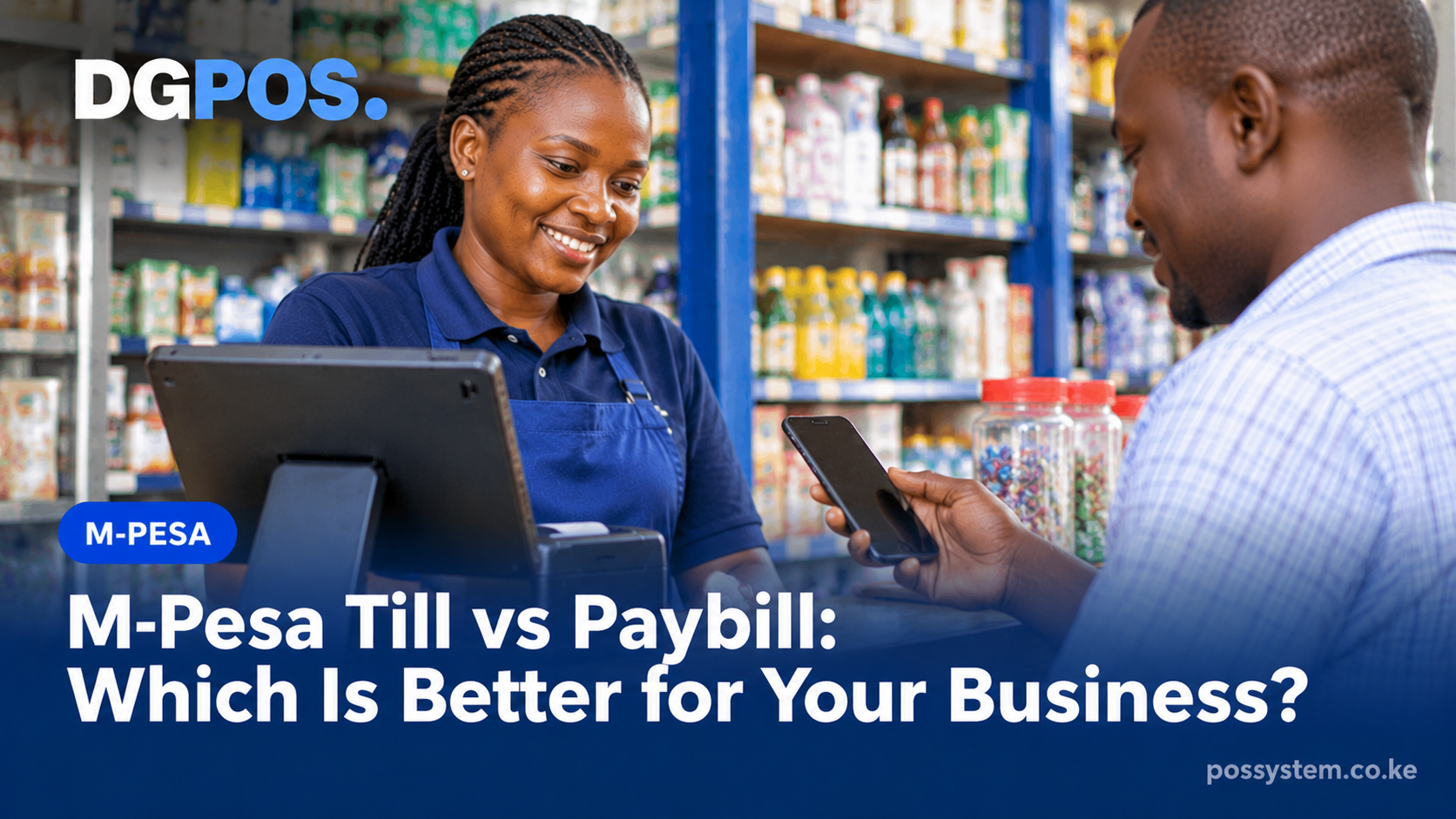
Choosing the right M-Pesa payment method is an important decision for any business in Kenya. Whether you operate a retail shop, supermarket, restaurant, online store, wholesale business, or service-based company, having a reliable way to receive customer payments can improve convenience, efficiency, and daily business operations.
Safaricom provides two popular business payment solutions: M-Pesa Till and Paybill. Although both allow businesses to receive payments through M-Pesa, they serve different purposes and offer different features. Understanding how each option works can help you choose a payment solution that matches your business needs.
In this guide, we explore M-Pesa Till vs Paybill, their differences, benefits, costs, and the types of businesses that can benefit from each option. We also explain how integrating a POS SYSTEM, POS, or Point Of Sale solution can help you manage transactions, monitor sales, and improve business operations.
At Digee Technologies Limited Company, we understand the importance of reliable business technology. Choosing the right payment method and adopting suitable pos software can help your business operate more efficiently and provide a better customer experience.
1. What Is M-Pesa Till?
M-Pesa Till, commonly known as Buy Goods and Services, is a payment solution that allows businesses to receive money directly from customers through M-Pesa.
Customers simply select the Lipa na M-Pesa option on their phones, choose Buy Goods and Services, enter the business Till number, confirm the amount, and complete the payment.
The payment is received through the business’s M-Pesa merchant account, making it convenient for businesses that regularly sell products or provide services to customers.
Benefits of M-Pesa Till
- Easy customer payments: Customers can pay directly using their M-Pesa accounts.
- Convenient transactions: Payments can be completed without handling physical cash.
- Suitable for retail businesses: Shops, restaurants, supermarkets, salons, and other businesses can use Till numbers.
- Improved payment tracking: Businesses can access transaction information and monitor received payments.
- Better customer experience: Customers can complete payments quickly and conveniently.
M-Pesa Till is particularly useful for businesses that receive frequent payments from walk-in customers and want a simple way to collect money.
2. What Is M-Pesa Paybill?
M-Pesa Paybill is a business payment solution that allows customers to send money to an organisation using a Paybill number and an account number.
Unlike a Till number, Paybill allows businesses to identify the purpose of individual payments through account references. For example, a school can use student admission numbers, while a utility company can use customer account numbers.
The customer selects Lipa na M-Pesa, chooses Paybill, enters the business Paybill number, provides the required account number, enters the amount, and confirms the payment.
Benefits of M-Pesa Paybill
- Account identification: Businesses can identify payments using customer account numbers or references.
- Organised payment records: Transactions can be associated with specific customers, accounts, or services.
- Suitable for recurring payments: Organisations can receive payments such as school fees, subscriptions, and service bills.
- Convenient collections: Customers can pay remotely without visiting the business premises.
- Improved payment management: Businesses can use transaction information to support reconciliation and financial reporting.
Paybill is particularly suitable for organisations that receive payments from many customers and need to identify what each payment is for.
3. M-Pesa Till vs Paybill: Key Differences
Understanding the difference between these two payment solutions is essential when deciding which one to use.
Although both solutions support cashless payments, they are designed for different business requirements.
| Feature | M-Pesa Till | M-Pesa Paybill |
|---|---|---|
| Main purpose | Receiving payments for goods and services | Receiving payments against customer accounts |
| Payment reference | Usually the business Till number | Paybill number and account number |
| Customer identification | Mainly through transaction details | Account number helps identify the customer or payment |
| Common users | Shops, restaurants, salons, retail outlets | Schools, utilities, service providers and institutions |
| Payment collection | Commonly used for direct sales | Commonly used for bills and account-based collections |
| Reconciliation | Based on transaction records | Can be organised using account references |
The most important difference is how payments are identified. A Till is generally designed for receiving payments for goods and services, while Paybill offers an account-reference structure that can make payment identification easier.
4. Which Is Better for Small Businesses in Kenya?
For small businesses, choosing between M-Pesa Till and Paybill depends on how the business receives payments.
A small retail shop, grocery store, clothing shop, restaurant, or salon may find M-Pesa Till more convenient because customers can pay directly for goods and services.
On the other hand, a business that collects payments against customer accounts may benefit more from Paybill.
For example:
- A supermarket selling products to walk-in customers may prefer a Till number.
- A restaurant receiving customer payments may find a Till convenient.
- A school collecting fees using student admission numbers may prefer Paybill.
- A service provider collecting monthly payments from customers may benefit from Paybill.
- A business offering subscriptions may use Paybill to help identify individual customer payments.
Before making a decision, consider your daily transaction volume, payment collection process, customer requirements, and record-keeping needs.
5. Understanding the Costs of M-Pesa Till and Paybill
Transaction charges are another important factor when comparing M-Pesa Till vs Paybill.
The applicable charges may vary depending on the payment service, transaction type, business arrangement, and Safaricom’s current tariff structure.
Some merchant payment services have different customer and merchant charging arrangements. Therefore, businesses should not assume that Till and Paybill have identical fees.
Before applying, consider the following:
- Customer transaction charges.
- Merchant transaction charges.
- Withdrawal charges.
- Applicable transaction limits.
- Settlement and withdrawal arrangements.
- Any additional service fees.
Always confirm the latest applicable charges directly with Safaricom before choosing a payment solution. This helps you understand the actual cost of receiving and accessing your business payments.
6. Why Businesses Should Combine M-Pesa Payments with a POS System
Receiving payments is only one part of running a successful business. Businesses also need to record sales, monitor stock, track transactions, and understand their financial performance.
This is where a POS SYSTEM becomes useful.
A POS solution helps businesses manage sales transactions and maintain organised business records. Depending on the features available, a Point Of Sale solution can support activities such as recording sales, managing inventory, generating receipts, and producing sales reports.
When a business combines an M-Pesa payment method with suitable pos software, it can improve the way it manages daily transactions.
Benefits of Using POS Software
1. Better Sales Management
A point of sale system allows businesses to record sales and monitor transactions. This makes it easier to understand daily business performance.
2. Improved Stock Control
A suitable pos software solution can help businesses monitor stock levels, identify fast-moving products, and know when to replenish inventory.
3. Accurate Transaction Records
A POS SYSTEM helps maintain organised sales records, reducing dependence on manual record-keeping.
4. Easier Business Reporting
A Point Of Sale solution can generate reports that help business owners review sales performance and make informed decisions.
5. Improved Customer Service
A reliable POS solution can make checkout processes more organised and efficient, helping customers complete purchases conveniently.
6. Better Business Organisation
A modern point of sales system can bring important business activities together, making it easier to manage sales, inventory, and daily operations.
7. How to Choose the Right Payment Solution for Your Business
Choosing between M-Pesa Till and Paybill requires an understanding of your business operations.
Here are important factors to consider:
A. Understand Your Business Model
Consider whether your business mainly sells products directly to customers or collects payments against individual customer accounts.
Businesses that sell directly to customers may find Till more convenient, while businesses that need account references may benefit from Paybill.
B. Consider Your Customers
Think about how your customers prefer to make payments. A convenient payment process can encourage customers to complete transactions and improve their overall experience.
C. Evaluate Your Transaction Records
If your business needs to identify individual customer payments, Paybill’s account-number structure may be useful.
If you mainly need to receive payments for daily sales, a Till number may be sufficient.
D. Consider Business Growth
Choose a payment solution that can support your current operations and future business requirements.
As your business expands, you may need additional technology such as a POS SYSTEM to manage increased sales, inventory, and transactions.
E. Compare Applicable Charges
Review the current tariffs and understand the costs associated with receiving and withdrawing business payments.
The best option is one that supports your operations while offering a suitable payment experience for your customers.
8. Common Mistakes Businesses Should Avoid
When choosing a payment solution, businesses should avoid making decisions without understanding how each service works.
Some common mistakes include:
- Choosing a payment option without considering business requirements.
- Ignoring transaction and withdrawal charges.
- Failing to keep proper payment records.
- Not checking whether customers can easily complete payments.
- Using manual sales records when the business needs better transaction management.
- Failing to reconcile M-Pesa payments with business sales.
- Choosing technology that cannot support future business growth.
Businesses can avoid many of these challenges by selecting the right payment solution and adopting suitable business management technology.
9. How Digee Technologies Limited Company Supports Business Digitalisation
Modern businesses need more than convenient payment methods. They also need reliable technology to manage daily activities, improve efficiency, and make better business decisions.
Digee Technologies Limited Company supports businesses through practical technology solutions designed to improve business operations and digital efficiency.
By adopting suitable business technology, businesses can improve how they manage sales, payments, customer information, and other important activities.
A suitable point of sale system can help businesses organise transactions, manage inventory, and generate useful sales reports.
Whether you operate a small retail shop, supermarket, restaurant, wholesale business, or growing enterprise, investing in the right technology can help create more organised business operations.
The combination of convenient M-Pesa payments and effective pos software can help businesses improve transaction management and serve customers more efficiently.
10. Frequently Asked Questions About M-Pesa Till vs Paybill
1. What is the main difference between M-Pesa Till and Paybill?
M-Pesa Till is mainly used by businesses to receive payments for goods and services. Paybill allows customers to make payments using a business number and an account reference, making it useful for identifying individual payments.
2. Is M-Pesa Till suitable for small businesses?
Yes. M-Pesa Till is suitable for many small businesses, including retail shops, salons, restaurants, grocery stores, and other businesses that receive direct customer payments.
3. Is Paybill better than Till?
Neither option is automatically better. The right choice depends on how your business collects payments. Till is convenient for direct sales, while Paybill is useful when payments need to be associated with customer account numbers.
4. Can a business use both Till and Paybill?
A business may apply for and use both services where eligible and where its operations require them. The business should confirm the applicable requirements and arrangements with Safaricom.
5. Can M-Pesa payments be managed using a POS system?
Yes, businesses can use a POS SYSTEM to record and manage sales alongside M-Pesa payments. The available level of integration depends on the particular POS solution and payment integration features.
6. Why does a business need POS software?
A business can use pos software to record sales, monitor stock, generate reports, and improve transaction management. The right Point Of Sale solution can reduce manual work and improve business organisation.
7. Which businesses benefit from a point of sale system?
Retail shops, supermarkets, restaurants, pharmacies, clothing stores, wholesalers, and many other businesses can benefit from a point of sale system.
8. Does a POS system replace M-Pesa Till or Paybill?
No. A point of sales system is used to manage sales and other business operations. M-Pesa Till and Paybill are payment collection services. They can complement each other when the required integration is available.
Conclusion
Choosing between M-Pesa Till and Paybill depends on your business model, customer payment preferences, transaction records, and operational requirements.
M-Pesa Till is generally suitable for businesses receiving direct payments for goods and services, while Paybill is useful for organisations that need customers to make payments against specific account references.
However, receiving payments efficiently is only one part of running a successful business. Combining a suitable M-Pesa payment solution with a reliable POS SYSTEM, POS, or Point Of Sale solution can help improve sales management, inventory control, and business reporting.
Digee Technologies Limited Company encourages businesses to embrace practical technology solutions that support efficiency, organisation, and long-term growth.